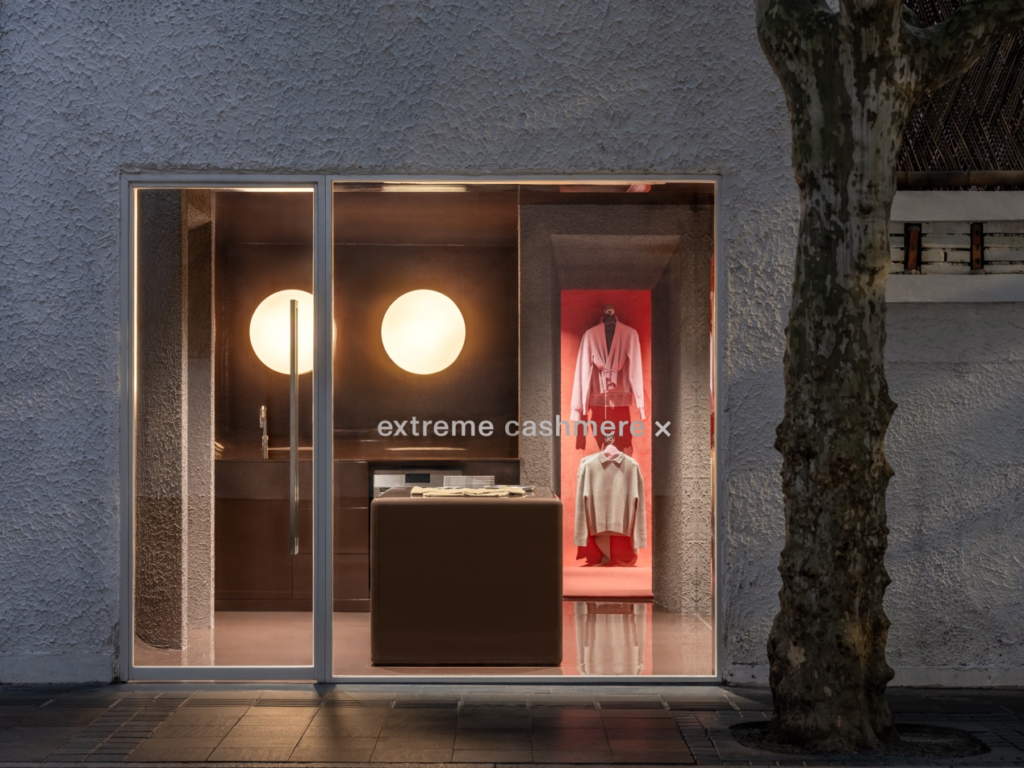
As reported on November 12, 2026, Dutch brand extreme cashmere had opened its first Shanghai flagship the previous month, in an old house at 63 Wukang Road. Rather than placing clothes at the entrance, the store leaves a six-metre stretch largely to the building’s dark tones and glossy surfaces. The cashmere appears farther inside.
The approach echoes the brand’s Amsterdam flagship, which opened in 2025 with an empty display window. There, visitors pass through velvet curtains into a room with an orange carpet, sofas and a kitchen island; folded sweaters sit in a niche in the island. Creative director Wies Verhoofstad said conventional clothing racks can overwhelm the eye and fail to present garments fairly.
In Shanghai, textured plaster arches connect the rooms. Deeper inside, the palette shifts to soft pink, with pale-pink carpet on the ground floor and ceiling-mounted curtains that can open or close the fitting area. Antique wall lights came from the Saint-Ouen flea market in Paris. Verhoofstad said the team chose Wukang Road partly for its tree-lined surroundings and foot traffic, but the traditional house itself was decisive.
A store intended to be used beyond shopping
Verhoofstad described the brand’s stores as “homes for the brand.” She said the Shanghai space could host activities such as courtyard tai chi and small literary gatherings. Traditional Chinese medicine massage was a future plan, not an existing service; she also mentioned community dog walks. The aim, she said, was for the store to be open to the community beyond retail hours.
A washing machine on the ground floor makes the brand’s garment-care message visible. Verhoofstad said customers can bring in the brand’s clothes for a cleaning service and learn how to care for them. She argued that dry cleaning can dry out cashmere fibres, while the brand intends its garments to be washed. That is the brand’s advice about its own clothing, not a washing instruction for every cashmere item. The Amsterdam store also offers cleaning, and the brand previously ran a temporary cashmere-care service with Miele during Paris Fashion Week.
The Shanghai opening follows a longer connection with China. Founder Saskia Dijkstra first visited the country about 20 years before the report and established relationships with local factories and partners. The brand also tested a pop-up on Julu Road about two years before the flagship opened.
Verhoofstad said extreme cashmere does not create a China-only collection: it selects products from four main Editions. She said coats had performed particularly well in China, while customers bought more pink, red and yellow than the team had expected. E-commerce was being planned, with feedback from the physical store intended to inform product selection; no online launch date was given.